
ElevenLabs - Best AI Voice Generation and Cloning Platform
FreemiumElevenLabs delivers the most realistic AI voice generation available, with instant voice cloning, multilingual support, and a growing ecosystem of voice tools for creators and developers.
Rated by our editorial criteria, not by paid placement.
Pricing, model access, and rights can change; verify final terms with the provider.
Outbound links may be affiliate links and do not affect the review verdict.
Tech Specs
Overview
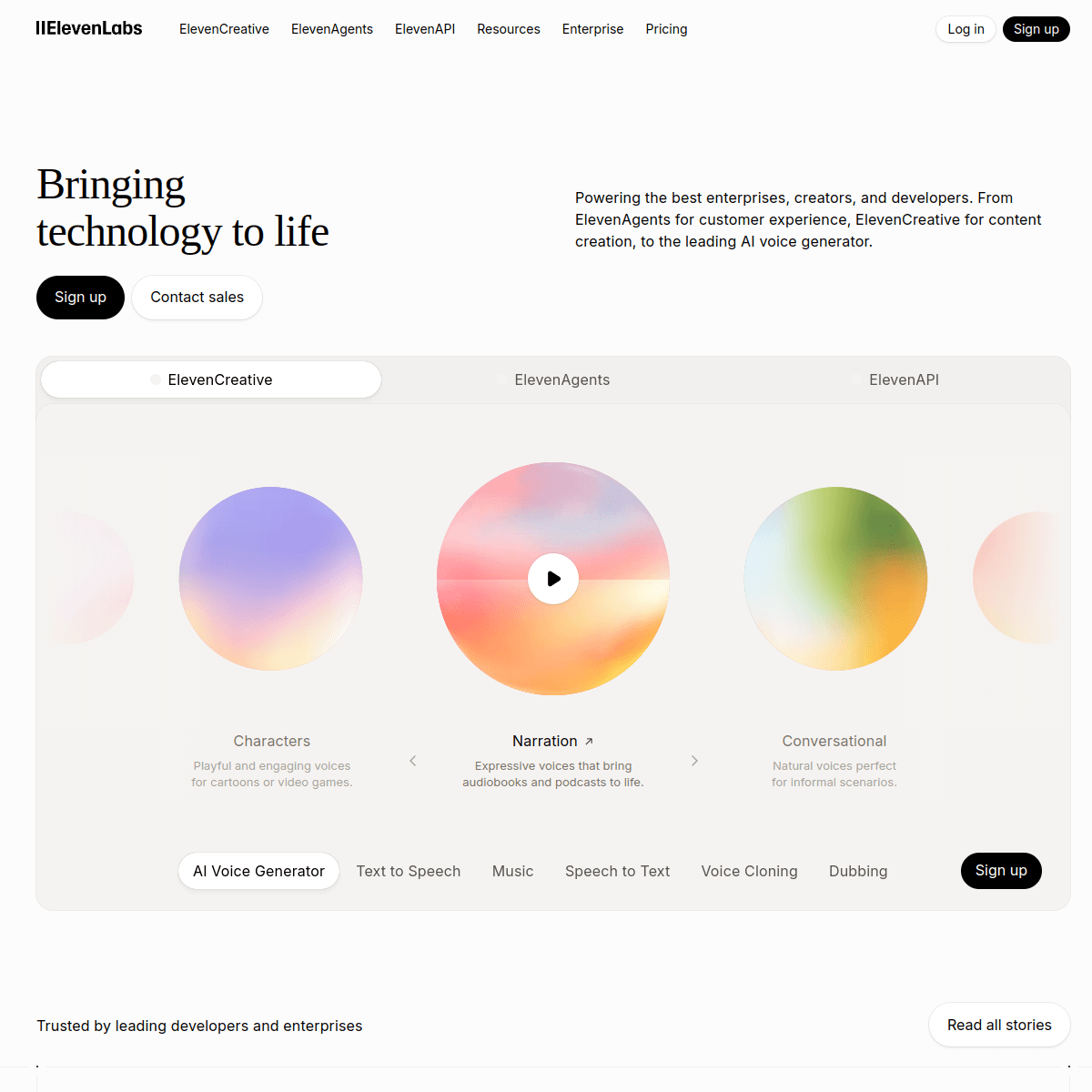
ElevenLabs is the leading AI voice generation platform. Its proprietary v3 model produces speech that is virtually indistinguishable from human voice acting. The platform supports text-to-speech, voice cloning, speech-to-speech conversion, and even sound effects generation — all through a web interface and a well-documented API.
Key Features
- Text-to-Speech: Type text and get natural-sounding speech in seconds. Choose from 1,000+ pre-made voices or create your own.
- Voice Cloning: Upload just 1 minute of audio and get an instant digital clone of any voice. Professional cloning requires more audio for best results.
- Multilingual: Generate speech in 29+ languages with the same voice. The AI adapts accent and pronunciation automatically.
- Speech-to-Speech: Record your own voice and convert it to another voice while keeping your delivery and emotion.
- Sound Effects: Generate custom sound effects from text prompts — a new capability for content creators.
- API: Full REST API for developers to integrate voice generation into apps and workflows.
Pricing Breakdown
| Plan | Price | Characters/Month | Features |
|---|---|---|---|
| Free | $0 | 10,000 | 3 custom voices, attribution required |
| Starter | $5/mo | 30,000 | 10 custom voices, commercial rights |
| Creator | $22/mo | 100,000 | 30 custom voices, API access |
| Pro | $99/mo | 500,000 | 160 custom voices, higher quality |
| Scale | $330/mo | 2,000,000 | 400 custom voices, priority support |
| Enterprise | Custom | Custom | Dedicated support, SLA |
Pros and Cons
Pros:
- Best-in-class voice quality — genuinely hard to distinguish from real human voice
- Fast generation — most clips render in under 5 seconds
- Excellent API with generous rate limits on paid plans
- Voice cloning is incredibly easy and accurate
- Multilingual support is a huge differentiator
Cons:
- Free tier is very limited (10k chars = ~2 minutes of speech)
- Voice cloning raises ethical concerns — be responsible
- Higher-tier plans are expensive for individual creators
- Some languages still have noticeable accent issues
Best Use Cases
ElevenLabs is strongest when voice quality directly affects the user's perception of the product. YouTube creators can produce narration without booking studio time, educators can turn lessons into audio, indie game teams can prototype character dialogue, and app developers can add natural speech to accessibility or language-learning experiences through the API.
It is also valuable for localization. Keeping a similar voice across languages can make training materials, product walkthroughs, or video explainers feel more consistent than hiring unrelated voice talent for every market. Teams should still review pronunciation and cultural tone because a technically fluent voice can still sound wrong for a specific audience.
Responsible Voice Cloning
Voice cloning is powerful enough that consent and documentation matter. Do not clone a voice unless you own the recording rights or have explicit permission from the speaker. For commercial work, keep a written record of consent, usage scope, and the plan used to generate the audio. This protects both the creator and the person whose voice is being modeled.
Businesses should create internal rules before letting teams use cloned voices. A safe policy usually includes approved voices, prohibited use cases, human review for public content, and a clear way to remove or replace a cloned voice if permission changes. The technology is excellent, but poor governance can create reputational and legal risk.
Workflow Tips
Shorter scripts produce more controllable output. Break a long narration into scenes or paragraphs, generate several takes, and then assemble the best versions in an editor. For emotional reads, add stage direction in the prompt or adjust the voice settings gradually instead of regenerating the entire script repeatedly.
For developers, the API is often the strongest reason to choose ElevenLabs over simpler text-to-speech tools. It can power dynamic narration, support agents, game dialogue, and interactive learning flows. Teams should test latency, caching, and character costs before putting voice generation into a high-volume production feature.
Who Should Skip It
Skip ElevenLabs if your use case is casual, low-volume, or highly price-sensitive. It is a premium tool, and the cost only makes sense when voice quality or API workflow is central to the product.
Verdict
ElevenLabs remains the benchmark for AI voice quality because it feels production-oriented instead of demo-oriented. When spoken output affects trust, polish, or conversion, it is one of the few tools that can genuinely justify a paid workflow.
If your project is more about music generation than narration, compare it with Suno. If you only need lightweight voiceover, cheaper text-to-speech options may be enough.